SpaceX First Report Card
The first quarterly report since the record listing beat the analyst estimate, tripled the burn, and lands two days before nearly a billion insider shares can leave the vault.
On Tuesday evening, the fourth of August, less than eight weeks after the record listing, SpaceX posted its first quarterly report as a public company. The release hit shortly after the four o'clock close and was digested by the after-hours tape into Tuesday night. The numbers arrived in the format the bulls asked for and the bears feared. Revenue beat by roughly a billion dollars. Losses narrowed to less than half of what most analysts had modeled. Starlink kept doubling. Artificial-intelligence-segment revenue more than tripled. Forward guidance escalated into terrain that would have been mocked, three months ago, by anyone reading the prospectus with a calculator. The stock had closed Tuesday's regular session at $125.33, up more than nine percent on the day, then reversed sharply in after-hours trading as the release landed, printing lows near $114 that put it, once again, close to half of what it was worth on the fourth day of its life.
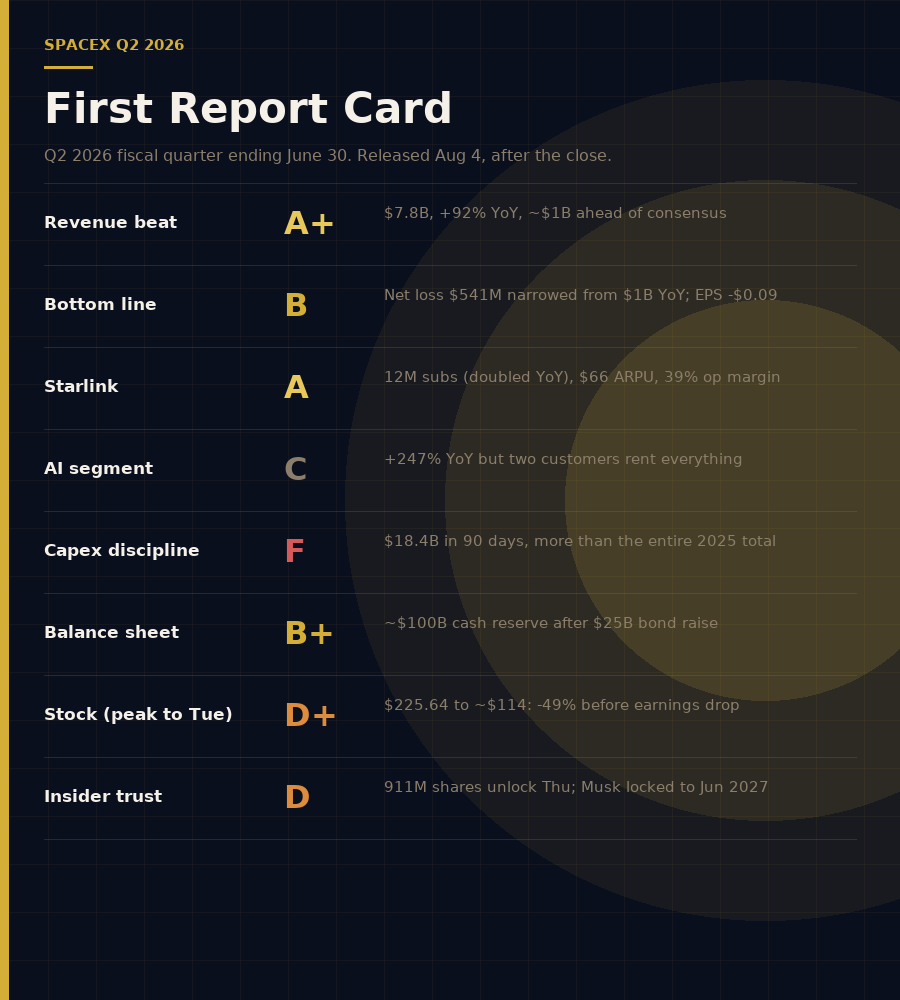
What the report actually said, read alongside the calendar, is that the carousel did not slow. It accelerated. Capital expenditure in the quarter came in at eighteen billion four hundred million dollars, more than the entire 2025 full-year figure, and more than double the first-quarter run rate on which the offering was priced. That figure is the machine's operating fingerprint. And on Thursday morning at the opening bell, the second full trading day after Tuesday's release, nearly nine hundred and eleven million shares held by insiders, twenty percent of the eligible locked-up stock, become saleable for the first time. The chief executive's own stake stays fenced until June 2027. Everyone else's does not.
What came true
Before the forensic move, the concessions. The bull case here has never been fantasy; the argument was always about the price. In the eight weeks since the debut, the bull case landed several of its promised deliverables.
Starlink is exactly what the bulls said it was. The Connectivity segment posted $4.3 billion of revenue in the quarter, up sixty-six percent year-over-year, on twelve million subscribers, a base that had doubled in twelve months. Average revenue per user held at sixty-six dollars a month, an unusually stable figure for a category that was, three years ago, still an experiment. The segment posted seventy-nine percent operating-income growth. In the ninety days that closed the quarter, another 1.7 million net additions arrived. That is a real utility, in real countries, serving real customers who pay every month. Nothing in the prior view disputed that, and nothing in the August print undermines it.
The launch monopoly is also, in most respects, what the bulls said. On the twenty-fourth of July, forty-two days after the listing, SpaceX put a Super Heavy-Starship v3 stack on the pad at Starbase for its thirteenth integrated test flight, the first since the offering. The booster separated cleanly. Its descent, less cleanly: only ten of thirteen Raptor engines relit for the landing burn, and only five were still running at the moment of a hard splashdown in the Gulf of Mexico. The upper stage, the piece that has broken up on prior flights, the piece that is the whole game for Mars and for the NASA Artemis lunar lander contract, flew its sub-orbital trajectory as designed, deployed its payload, and made a rocket-powered splashdown northwest of Australia, roughly an hour and five minutes after launch, remaining fully intact on the water. On the same flight, the company deployed twenty of its new Starlink V3 satellites, the payload the whole Starship program was engineered to justify. Six of those satellites carried cameras and turned back to inspect the vehicle they had ridden, the first real-world imagery of an intact heat shield on a returning upper stage. The chief executive, on his own platform, called it a step-change. The camera did not disagree. The May flight had been ugly, engines out on the booster and a near-scrub on the upper stage. The July flight, hard booster splashdown and all, was not.
Concede those two facts up front, because they are the strongest part of the bull case and they are load-bearing. The rockets flew. The utility scaled. If either premise had failed on July twenty-fourth or on August fourth, this would be a shorter and much simpler article, and it would be filed in a different section.
Now the parts that did not go forward.
The burn
The alarm bell the IPO prospectus rang loudest was capital expenditure. It disclosed $12.7 billion for the full year 2025, and another $7.7 billion in the first quarter of 2026 alone, poured into data-center construction and the racks of Nvidia processors that would live inside. The pace was the story. Any first-year audit reader could see, from the trailing four-quarter trend, that the machine was accelerating its cash outflow into infrastructure at a rate that would consume the offering proceeds inside a small number of quarters.
Tuesday's release did not slow the rate. It accelerated it. Second-quarter capital expenditure landed at $18.4 billion, more than the entire 2025 total, more than double the first-quarter run rate. Fifteen point eight of those eighteen and a half billion dollars, eighty-six cents on every dollar of quarterly capex, went into the AI segment: data-center racks, cooling, substation upgrades, land, GPUs. In ninety days SpaceX consumed more cash on plant and infrastructure than it had in any twelve-month period of its previous existence. That eighteen-billion figure is not a rounding, not a smoothed accrual, not an aggressive year-forward view. It is the true operating fingerprint of the machine, and the reason the stock reversed sharply after hours despite a revenue beat that would have carried any other name.
The company met the shortfall the way companies at this scale meet shortfalls. It raised twenty-five billion dollars in a bond issue during the quarter, added it to the offering proceeds, and reports a roughly one-hundred-billion-dollar cash reserve on the balance sheet. That reserve is a genuine cushion. It is also, at the current run rate of eighteen and a half billion dollars a quarter, a runway one measures in single-digit quarters if the trajectory continues.
Blend the numbers. Revenue rose ninety-two percent year-over-year to $7.8 billion, roughly a billion dollars ahead of consensus in the weeks before the print. Net loss narrowed to $541 million, better than the roughly $1 billion loss of the year-ago quarter, and better than the analyst range, which spanned from a $1.26 loss to a $0.33 gain per share and closed at expectations that were, on any charitable read, wide because no one knew what the machine actually looked like in the daylight. Loss per share came in at nine cents. Adjusted EBITDA landed at $3.5 billion. The Connectivity segment did the compounding, including $1.8 billion of enterprise and government revenue that alone grew a hundred and eight percent. The AI segment did the announcement. And underneath both, the balance sheet drew eighteen and a half billion dollars out of the treasury to keep the story financing itself.
The Anthropic pipe explains the top line and the burn at the same time. On May the sixth, three weeks before the roadshow began, Anthropic, the AI lab backed by Google and Amazon, signed a compute-purchase agreement with xAI worth up to forty-five billion dollars over the life of the contract, at a rate of $1.25 billion a month through May 2029. Its magnitude showed up in the second-quarter print: AI-segment revenue rose two hundred and forty-seven percent year-over-year to $2.6 billion. That growth rate is the headline. It is also arithmetic. Anthropic is paying fifteen billion dollars a year to rent the compute that xAI built for itself and cannot yet consume. When that rent flows into the income statement, revenue grows two hundred and forty-seven percent. When either party gives ninety days' notice, revenue does not.
The label for this arrangement earned itself in the prospectus. The August print did not disprove it. It printed the receipts, on the timetable the offering agreed to, in the format the bankers preferred.
The one-hundred-billion promise
On the earnings call the chief financial officer, Bret Johnsen, offered a forward number that will be quoted for months. He said SpaceX is on a trajectory to reach one hundred billion dollars in annualized recurring revenue by the end of the year, and offered, in the same breath, a concrete data point in support: "in the first few weeks of Q3, we've already contracted an additional $6.7 billion of cloud services revenue" over a six-month period that begins ramping in October. The chief executive, taking the mic after him, was less careful. He described the figure as "not a question mark" and suggested it could be higher. In the pattern of the last decade of Musk earnings calls, the founder's certainty ran ahead of the finance chief's carefulness by about half a sentence.
Read literally, the sentence is stunning. Second-quarter revenue was $7.8 billion. Annualize that and the run rate is $31.2 billion. To reach one hundred billion of ARR by December, even on the softer, forward, contract-included definition ARR always carries, would require the quarterly base to triple again inside two quarters. The math demands Anthropic's monthly cheque to expand, Google's monthly cheque to expand, Starlink to keep adding subscribers at pace, launch revenue to accelerate, and a new AI-consumption product the executives named as Cursor (the sixty-billion-dollar all-stock acquisition SpaceX announced on the sixteenth of June, built by Anysphere, expected to close as a wholly owned subsidiary in the current quarter) to contribute at a magnitude the acquired company has not previously disclosed at that scale. Johnsen described the underlying AI economics as "less than a one-year payback" on the capital being deployed. That is another way of saying: the machine's cost of building capacity is being sold, on paper, back to the machine at a multiple that makes the payback look short.
Read charitably, the executive is speaking of an exit run-rate that includes contract commitments not yet earned, the un-amortized portion of Anthropic's roughly forty-five-billion-dollar, four-year deal; the multi-gigawatt space-compute arrangement Anthropic and SpaceX described in May as an "interest," not a signature; the Google monthly commitment; the additional $6.7 billion of cloud services just contracted in July; a Starlink base at twelve million subscribers scaled forward on the current run rate; and Cursor. Read cynically, ARR is a frame. It is the frame in which a contract signed with a ninety-day mutual out is counted, at its annualized headline value, as revenue the company has already earned. It is the same frame that produced, in a different marquee name, the $5.9 billion equity-method gain on Microsoft's Q1 stake in OpenAI, a bookkeeping technology that turns paper commitments into recognized outperformance while the paper itself is still just paper.
That figure, one hundred billion dollars of ARR by December, is the number the market carried into the earnings release and the number the after-hours tape stopped believing. SpaceX closed the regular session on Tuesday, before the release, at $125.33, up nine and a half percent on the day. The release hit shortly after the four o'clock close. Within ninety minutes the after-hours ticker had traded down more than six percent to the mid-hundred-and-teens, printing an intraday after-hours low near $114 on the eight-and-a-half-percent worst quotes as the capital-expenditure line came into focus. The tug-of-war between the headline and the receipt is the entire trade. Wednesday's regular session opens in a few hours as this piece is filed; how the tape closes on Wednesday and Thursday is what will decide whose reading of the release was right.
The front-run
On the sixteenth of June, the second trading day after Friday's debut, SPCX printed $225.64, the all-time high, established during the underwriters' price-stabilization window and the frenzy of a listing that had been oversubscribed by more than two to one. That same day, SpaceX announced a sixty-billion-dollar all-stock acquisition of Cursor, the AI coding company built by Anysphere; the deal is expected to close in the third quarter and is the largest venture-backed startup acquisition in history. The peak and the sixty-billion-dollar-M&A headline landed inside the same session. Since then the tape has been descending. By the twenty-eighth of July the same shares traded at $107.01, the all-time low, off roughly fifty-three percent from the peak. Tuesday's after-hours print near $114 sat little more than seven dollars above the intraday floor of one week earlier. The stock has lost roughly two hundred and fifty billion dollars of market capitalization since the peak. Fortune, on Tuesday, ran the headline "SpaceX stock has lost half its value" as its lead take on the earnings.
Two things about that drawdown are worth naming.
First, it happened without a single negative operational catalyst. Starship IFT-13 worked. Starlink kept scaling. The Anthropic contract remained in force. The chief executive gave no ill-advised interview, launched no rival product, insulted no customer of consequence. The stock fell roughly fifty-three percent across the six weeks between the sixteenth of June and the twenty-eighth of July against a background of no bad news at all. That is what a valuation reset looks like when a listing has been priced at its ceiling and the buyers have finished distributing to each other. It is also what happens when a two-and-a-half-trillion-dollar promise is asked, quietly, to justify itself against an $18.4 billion quarterly capital expenditure.
Second, the shape of the drawdown lines up with something specific on the calendar. It is not random. It is the market front-running the lock-up.
The exit door opens
The prospectus made the lock-up terms available to anyone who read past the offering summary. Only a fraction of readers did.
The insider stock, the equity held by SpaceX employees, early venture backers, secondary buyers from the pre-IPO tender window, and Musk himself, was locked at the listing under a staggered release schedule that was described, in the offering documents, as engineered to protect the market from the flood. On Thursday, August the sixth, the second full trading day after the first quarterly earnings release, twenty percent of the eligible locked stock becomes available for sale. That is up to nine hundred and eleven and a half million shares, roughly one billion, that could not trade on Wednesday and can trade on Thursday morning.
Not all of that stock will sell. Some belongs to employees who intend to hold through vest cliffs and family plans. Some belongs to long-time venture backers who have already distributed to their limited partners and will wait for the next tranche. But some of it will sell. That is the entire mechanical purpose of a staggered lock-up: to make it possible, and profitable, to sell early without vaporizing the price. Jim Cramer, in coverage around the earnings, told his audience to wait for lock-up expiration before buying. He is not the only voice saying it. The chart of the six weeks between the peak and the low has been saying it in every trading session.
By the eighth of December, cumulative unlocks could bring as much as forty percent of the company's shares into tradability. The remaining sixty percent, including Musk's 6.4 billion shares, stays fenced. Musk's own stake is locked until the fourteenth of June, 2027, when it too becomes eligible for sale, with no early-release provision.
Read the staggering as either statesmanship or choreography. The bull reads statesmanship: the founder subordinates his own liquidity to the company's, buying the market a full year of stability at the top of the capitalization table. The bear reads choreography: the founder is the last person off the ride, which is exactly what the ride's designer would be, and by the time his own release arrives, some ten months from now, the rest of the stack will have found new hands. Both readings are internally consistent. Both are compatible with the price action of the last two months. The market is not waiting for information. It is repricing the deal, on a schedule that was published in June.
The denominator, again
Call this the denominator illusion. A ratio celebrated without its base. AI revenue was up two hundred and forty-seven percent year-over-year. Truly. The base a year ago was small. The segment consolidated in February, when xAI was folded into SpaceX in the all-stock deal that turned a rocket-and-satellite company into the majority owner of a set of losses that used to sit in a private companion vehicle. Any consolidation of a large loss-making entity into a smaller profitable base will, in the first four quarters after the combination, produce dazzling percentage moves that describe accounting geometry rather than operating traction.
Strip the accounting. AI revenue at the quarterly run rate of $2.6 billion, annualized, is $10.4 billion. Anthropic, at $1.25 billion a month, contributes fifteen. Google, at roughly $920 million a month, contributes eleven. Two customers on ninety-day mutual outs contribute more revenue than the entire segment shows for the twelve-month annualization. The remainder is subtraction and mix: commercial revenue short of the rented capacity because the ramp is not yet complete, xAI's own Grok subscription revenue, some smaller enterprise deals, netted against the fact that the Anthropic contract carried a discount for its first two months of ramp.
The segment, in plain reading, is the two rival AI labs. Its two hundred and forty-seven percent growth is the arrival of those two labs' rent in the quarterly totals. It is not thousands of new enterprise customers. It is not consumer adoption of Grok at scale. It is not the algorithmic proof of the platform. It is a lease.
Compare with the Connectivity segment. Sixty-six percent year-over-year growth on twelve million subscribers, adding 1.7 million net in the quarter, an average customer paying sixty-six dollars a month. That is many small customers, of many kinds, in many countries. It is a fundamentally different quality of revenue. And it is the segment the market will keep buying, at any multiple, when the AI segment is asked to justify itself on the ninety-first day.
What would have to be true for the bulls
Concede the strongest form of the bull case, because it is not a caricature.
For a market capitalization of one and a half trillion dollars to prove cheap, Starlink must reach thirty or forty million subscribers on economics that hold at scale, and it must do so on the back of Starship V3, which is exactly what the vehicle that flew on the twenty-fourth of July was designed to enable. Twenty V3 satellites left the payload bay on that flight. Hardware on orbit, reporting. The bull reads: on schedule.
For the AI segment to justify its capital expenditure, xAI must convert the Colossus infrastructure from a rented block of GPU-time into a differentiated platform with its own consumer and enterprise customers, and it must do so before either Anthropic or Google files a ninety-day notice. The bull reads: Anthropic's own interest in gigawatt-scale space compute, publicly acknowledged in May at the same press conference as the ground-side contract, is a directional commitment that would rewrite the ninety-day-notice risk from a threat into a bridge to a much larger multi-decade infrastructure partnership.
For the one hundred billion of ARR to be roughly plausible on any reading, the exit run-rate must be measured on aggressive but not fraudulent methods, and the market must accept ARR as a leading indicator of GAAP revenue rather than a marketing frame. The bull reads: SaaS taught the market to do this a decade ago, and the durable-contract nature of Anthropic's four-year commitment is not qualitatively different from an enterprise software contract of the same length. The bull reads further: Starship reduces launch cost per kilogram to a level where entirely new categories of revenue become plausible in ways the historical launch business cannot forecast, and pricing for those categories is not a matter of subscriber counts but of physics.
None of those readings are unavailable. Each requires several things to break in the same direction across several years, in the face of a competing labor pool of GPUs already committed to the buyers who wrote the checks, and a global sovereign and antitrust regime that will not remain quiet forever about a single company that carried, in 2025, more than eighty percent of the world's payload mass and has quietly become the largest artificial-intelligence landlord on the continent.
If the bull is right, the stock at $114 is a gift. If the bear is right (and the July twenty-eighth intraday low may reflect nothing more than the market beginning, tentatively, to say so), the stock at $114 is closer to fair than the peak at $225 ever was, and the drawdowns of the coming six months will feel less like a correction and more like a schedule.
The kicker
The August print produced the receipts, in the format the designers preferred, on the timetable the underwriters agreed to. The rockets flew. The utility scaled. The rent arrived. The burn tripled. The share price halved from the top. And on Thursday morning at the opening bell, one trading session after Wednesday's regular open, roughly nine hundred and eleven million shares that could not leave the vault before then walk out, for the first tranche, into a market that has spent six weeks preparing for exactly that door to open.
The carousel did not stop. It sped up. And on Thursday morning, the first riders find out whether they can step off.
Disclaimer
This article is produced for informational and educational purposes only and does not constitute investment advice, a solicitation, or a recommendation to buy or sell any security. All data cited reflects information available as of the publication time noted above. Market conditions may change materially between publication and when you read this. Past performance of any strategy referenced is not indicative of future results. Consult a qualified financial advisor before making investment decisions.
SpaceX First Report Card
The first quarterly report since the record listing beat the analyst estimate, tripled the burn, and lands two days before nearly a billion insider shares can leave the vault.
The Compute Carousel
Inside the $1.77 trillion listing where rockets, satellites and a money-losing AI lab orbit a single man — where insiders hold the early exits, ordinary savers are routed in on autopilot, and the safe…
Uber Finally Turned a Profit, Just as the Cars Learned to Drive Themselves
Uber spent fifteen years and tens of billions of dollars proving it could exist, and it has finally won the argument: it is profitable, generating more than $2 billion of free cash flow a quarter, wit…
Microsoft Booked a $5.9 Billion Gain on a Company That Loses Billions
Microsoft is the bluest of blue chips, the steadiest mega-cap in the market, a fortress of recurring software profits. So it is worth pausing on a line buried in its accounts: over the nine months end…